Asian ginseng
| Page Content |
Introduction
[Top]
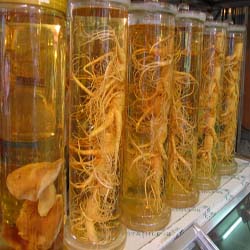
Asian ginseng is also known as panax-ginseng. It grows in Russia and East Asian but is indigenous to Korea and China. It belongs to the Araliaceae family, other members of the family include panax quinquefolius (American ginseng) and Eleutherococcus senticosus (Siberian ginseng). You can usually find it growing on the mountain slopes. There are two forms of panax, white and red.
- The white form is grown for 4 to 6 years, and then dried and peeled to decrease water content to twelve percent or less. It is air-dried and might have less therapeutic elements.
- The red form is harvested after 6 years; it is steam-cured and not peeled. When the root is steamed it is believed to alter its biochemical composition. After this, the roots are dried.
What panax is used for
[Top]
In traditional Chinese medicine philosophy, panax encourages Yang energy, increases blood supply, improves circulation, revitalizes, and helps recovery from illness as well as stimulating the body. It is also used to treat erectile dysfunction, menopausal symptoms, and hepatitis C. Panax is also employed for controlling blood pressure and lowering blood glucose.
How panax is used
[Top]
Panax root is first dried and employed to create capsules, tablets, teas, extracts, and creams.
Science Says
[Top]
Panax root has active chemical components known as ginsenosides or saponins. They are believed to be accountable for panax's medicinal properties. The April 2007 ,Cancer Chemotherapy and pharmacology issue, carries a study, in which 11 saponins were taken from the panax fruits, they were then purifed and their chemical structures were examined and evaluated against other human cancer cells. They concluded that the information that obtained from the results would be useful for developing anti cancer agents. http://link.springer.com/article/10.1007/s00280-006-0300-z
HIV
A study published in clinical and vaccine immunology showed that Korean red ginseng had positive effects when combined with HAART. CD4+T cell counts were maintained and there was a delay in the development of mutations in patients with HIV-1 that have had HAART treatment. http://www.ncbi.nlm.nih.gov/pmc/articles/PMC2725544/Diabetes
Researchers tested the safety and antidiabetic efficacy of 12 weeks of panax supplements. The results showed that panax improved insulin and glucose regulation in people with type 2 diabetes. Source: http://www.sciencedirect.com/science/article/pii/S0939475306001098Alzehimer's disease
Researchers in Seoul, South Korea, investigated whether panax had positive effects on the cognitive performance of Alzheimer disease patients. After 12 weeks of panax treatment the results suggested that panax improves the cognitive performance of Alzhemier's patients. http://www.ncbi.nlm.nih.gov/pubmed/18580589Korean chicken and ginseng soup
[Top]
If you are feeling unwell or in need of a bit of a boost try samgyetang. This is a korean chicken soup and like the chicken soup in the west it is believed to have medicinal qualities.
Ingredients
- Glutinous rice
- 4 cloves of garlic
- Ginger
- Red dried dates
- 8 peeled chestnuts
- Astragalus
- Danggwi
- Wolfberry
Cautions and side effects
[Top]
When taken orally, panax is generally well tolerated. Typical side effects are gastrointestinal problems,headaches and sleep problems. Panax may cause allergic reactions. Panax might lower blood sugar levels. Therefore, diabetics should exercise extra caution when using panax.
Return from Asian ginseng to natural healing home page


Loading
New! Comments
Have your say about what you just read! Leave me a comment in the box below.